
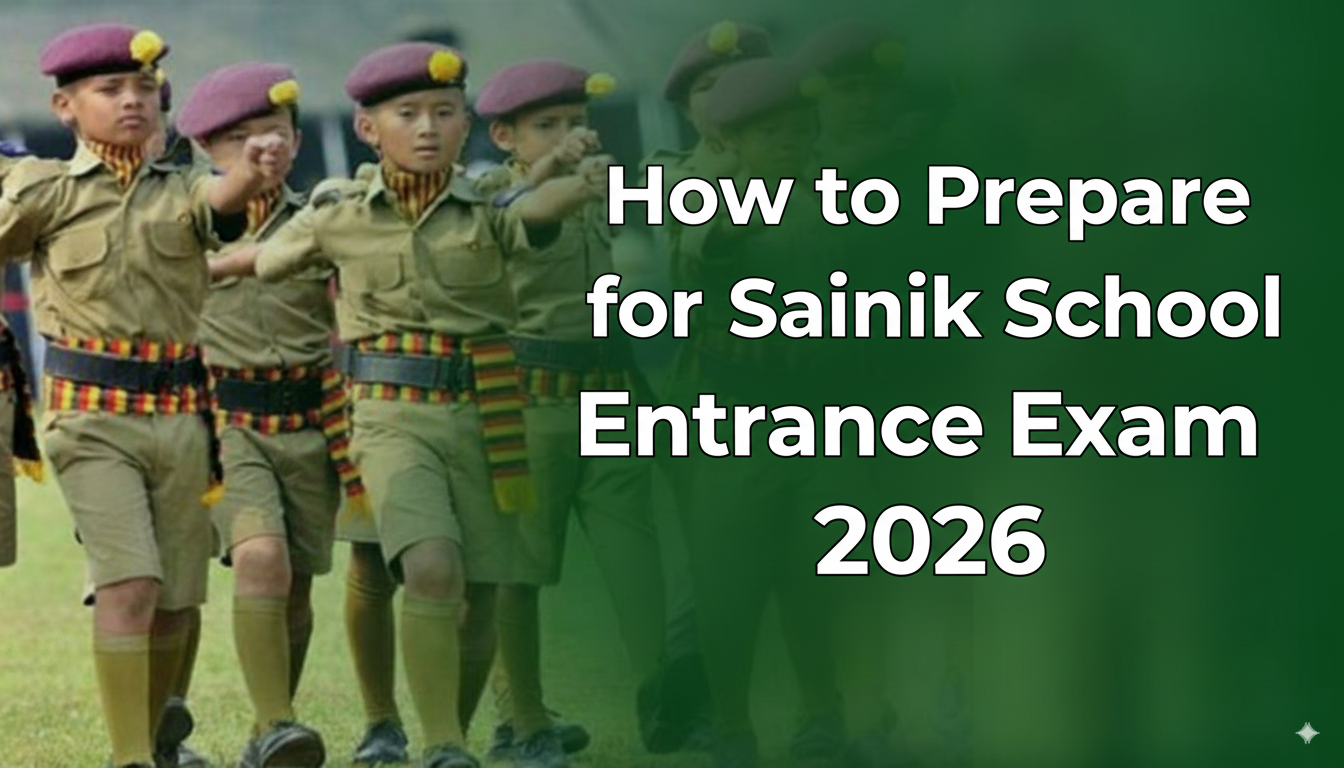
"How to Prepare for Sainik School Entrance Exam 2026 – Complete Guide"
Sainik Schools are a system of schools in India established and managed by the Sainik Schools Society under the Ministry of Defence. They prepare students for entry into the National Defence Academy (NDA) and other officer training academies. The Sainik School Entrance Exam (AISSEE) is a highly competitive examination. Here’s a complete guide to help you prepare for the 2026 exam:
- Understand the Exam Pattern and Syllabus
The AISSEE typically comprises subjects like Mathematics, General Knowledge, English/Hindi (Language), and Intelligence.
- Mathematics: This is often the most crucial section, covering topics like numbers, arithmetic operations, fractions, decimals, percentages, profit and loss, simple interest, area, volume, time and distance, etc.
- General Knowledge: Includes questions on history, geography, civics, general science, current affairs, sports, and important personalities.
- Language (English/Hindi): Focuses on grammar, vocabulary, comprehension, sentence formation, antonyms, and synonyms.
- Intelligence: This section tests logical and analytical reasoning abilities through questions involving series, analogies, classification, coding-decoding, and spatial reasoning.
- Create a Study Schedule A well-structured study plan is essential.
- Allocate Time: Dedicate specific time slots for each subject. Give more time to subjects you find challenging.
- Daily Goals: Set achievable daily or weekly study goals.
- Breaks: Incorporate short breaks to avoid burnout and maintain focus.
- Consistency: Stick to your schedule as much as possible.
- Gather Study Material
- NCERT Books: These are highly recommended for the foundation of Mathematics, Science, and Social Science subjects up to Class 8.
- Reference Books: Look for specific AISSEE preparation guides from reputable publishers.
- Previous Year Question Papers: These are invaluable for understanding the exam pattern, question types, and time management.
- Newspapers & Magazines: For current affairs and general knowledge.
- Subject-wise Preparation Strategy
- Strong Fundamentals: Master basic concepts and formulas.
- Practice Regularly: Solve a variety of problems every day.
- Speed & Accuracy: Focus on solving problems quickly and correctly.
- Mental Math: Improve your ability to do calculations without a calculator.
- Read Widely: Stay updated with current events by reading newspapers, news apps, and watching news channels.
- Make Notes: Jot down important facts, dates, and events.
- Focus on Indian Context: Pay attention to Indian history, geography, and political system.
- Static GK: Learn about important awards, books, discoveries, and inventions.
- Grammar: Understand and practice rules of grammar (tenses, parts of speech, articles, prepositions).
- Vocabulary: Learn new words daily, along with their meanings, synonyms, and antonyms.
- Reading Comprehension: Practice reading passages and answering questions based on them.
- Writing Skills: Practice writing short paragraphs or essays.
- Logical Reasoning: Solve puzzles, series, analogies, and coding-decoding problems.
- Observation Skills: Pay attention to details in figures and patterns.
- Practice Diversely: Work on different types of intelligence questions.
- Practice with Mock Tests
- Regular Mock Tests: Start taking full-length mock tests a few months before the exam.
- Time Management: Practice completing the paper within the given time limit.
- Analyze Performance: After each mock test, review your answers, identify weak areas, and work on improving them.
- Simulate Exam Conditions: Take mock tests in a quiet environment, without any distractions.
- Revision
- Regular Revision: Don’t just study new topics; regularly revise previously covered material.
- Short Notes: Create concise notes or flashcards for quick revision of important formulas, facts, and concepts.
- Focus on Weak Areas: Dedicate extra revision time to subjects or topics where you struggle.
- Physical Fitness
- Exercise Regularly: Engage in physical activities like running, cycling, or playing sports.
- Balanced Diet: Eat nutritious food.
- Adequate Sleep: Ensure you get enough rest.
- Maintain a Positive Attitude
- Stay Motivated: Believe in yourself and your abilities.
- Manage Stress: Don’t let exam pressure overwhelm you. Take breaks and engage in hobbies.
- Seek Support: Discuss your doubts with teachers, mentors, or parents.
